HOMER: Provable Exploration in Reinforcement Learning

Last week at ICML 2020, Mikael HenaffAkshay KrishnamurthyJohn Langford and I had a paper on a new reinforcement learning (RL) algorithm that solves three key problems in RL: (i) global exploration, (ii) decoding latent dynamics, and (iii) optimizing a given reward function. Our ICML poster is here.

The paper is a bit mathematically heavy in nature so this post is an attempt to distill the key findings. We will also be following up soon with a new codebase release (more on it later).

Rich-observation RL landscape

Consider the combination lock problem shown below. The agent starts in the state s1a or s1b with equal probability. After taking h-1 actions, the agent will be in either state sha, shb, or shc. The agent can take 10 different actions. The agent observes a high-dimensional observation (focus circle) instead of the underlying state which is latent. There is a big treasure chest that one can get after taking 100 actions. We view the states with subscript “a” or “b” as “good states” and one with subscript “c” as “bad states”. You can reach the treasure chest at the end only if you remain in good states. If you reach any bad state, then you can never make it to the treasure chest.
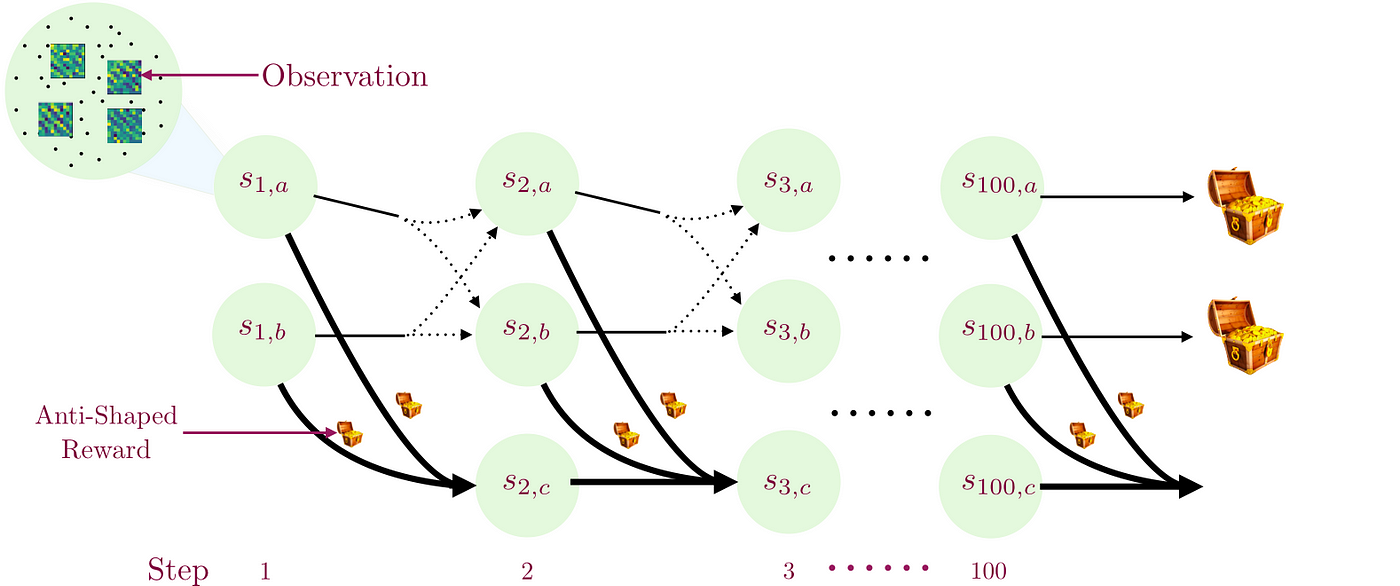
The environment makes it difficult to reach the big treasure chest in three ways. First, the environmental dynamics are such that if you are in good states, then only 1 out of 10 possible actions will let you reach the two good states at the next time step with equal probability (the good action changes from state to state). Every other action in good states and all actions in bad states put you into bad states at the next time step, from which it is impossible to recover. Second, it misleads myopic agents by giving a small bonus for transitioning from a good state to a bad state (small treasure chest). This means that a locally optimal policy is transitions to one of the bad states as quickly as possible. Third, the agent never directly observes which state it is in. Instead, it receives a high-dimensional, noisy observation from which it must decode the true underlying state.

It is easy to see that if we take actions uniformly at random, then the probability of reaching the big treasure chest at the end is 1/10100. The number 10100 is called Googol and is larger than the current estimate of number of elementary particles in the universe. Furthermore, since transitions are stochastic one can show that no fixed sequence of actions performs well either.

A key aspect of the rich-observation setting is that the agent receives observations instead of latent state. The observations are stochastically sampled from an infinitely large space conditioned on the state. However, observations are rich-enough to enable decoding the latent state which generates them.

What does provable RL mean?

A provable RL algorithm means that for any given numbers ed in (0, 1); we can learn an e-optimal policy with probability at least 1-d using a number of episodes which are polynomial in relevant quantities (state size, horizon, action space, 1/e, 1/d, etc.). By e-optimal policy we mean a policy whose value (expected total return) is at most e less than the optimal return.

Thus, a provable RL algorithm is capable of learning a close to optimal policy with high probability (where the word high and close can be made arbitrarily more refined), provided the assumptions it makes are satisfied.

Why should I care if my algorithm is provable?

There are two main advantages of being able to show your algorithm is provable:

  1. We can only test an algorithm on a finite number of environments (in practice somewhere between 1 and 20). Without guarantees, we don’t know how they will behave in a new environment. This matters especially if failure in a new environment can result in high real-world costs (e.g., in health or financial domains).
  2. If a provable algorithm fails to consistently give the desired result, this can be attributed to failure of at least one of its assumptions. A developer can then look at the assumptions and try to determine which ones are violated, and either intervene to fix them or determine that the algorithm is not appropriate for the problem.

HOMER

Our algorithm addresses what is known as the Block MDP setting. In this setting, a small number of discrete states generates a potentially infinite number of high dimensional observations.

For each time step, HOMER learns a state decoder function, and a set of exploration policies. The state decoder maps high-dimensional observations to a small set of possible latent states, while the exploration policies map observations to actions which will lead the agent to each of the latent states. We describe HOMER below.

  • For a given time step, we first learn a decoder for mapping observations to a small set of values using contrastive learning. This procedure works as follows: collect a transition by following a randomly sampled exploration policy from the previous time step until that time step, and then taking a single random action. We use this procedure to sample two transitions shown below.
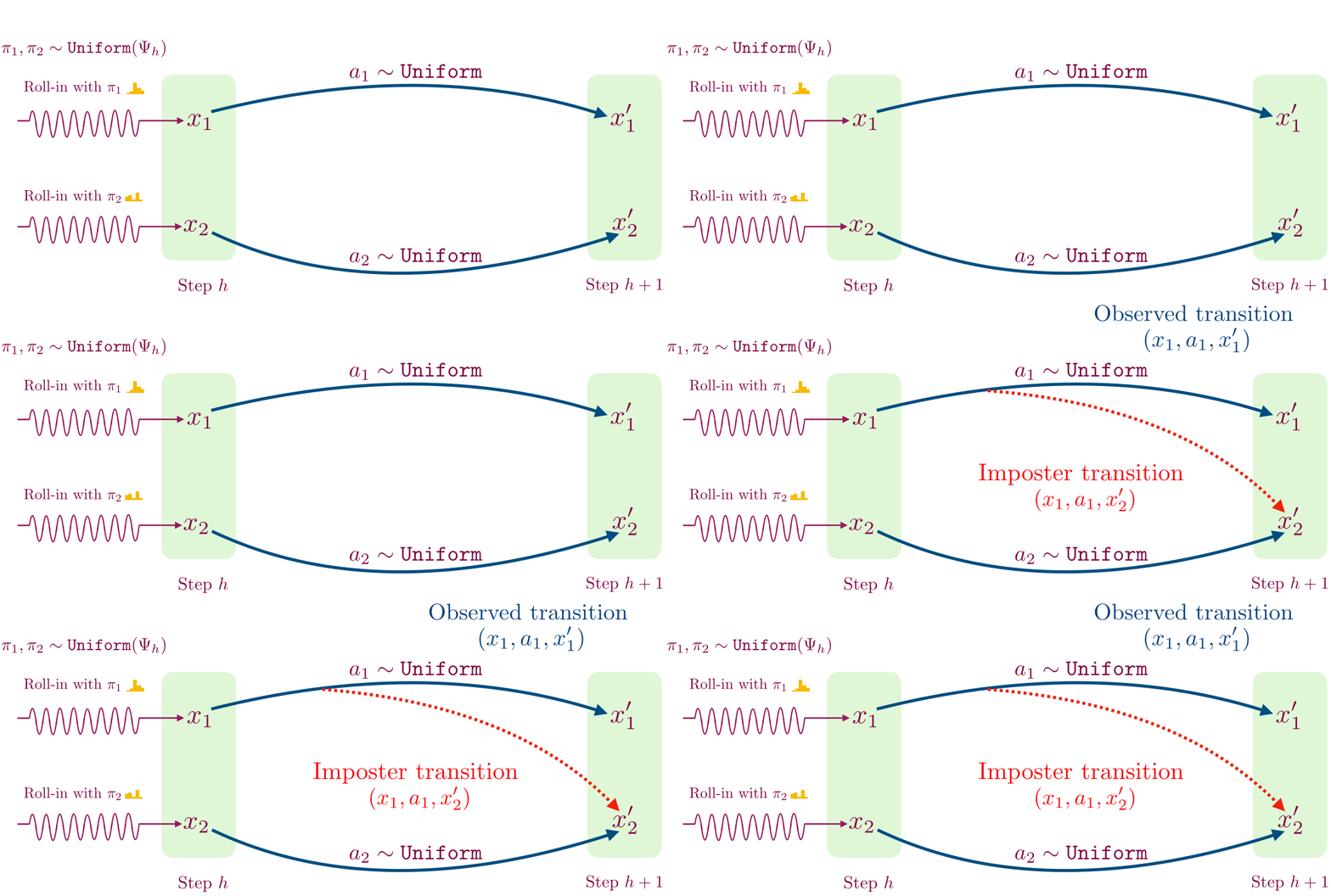
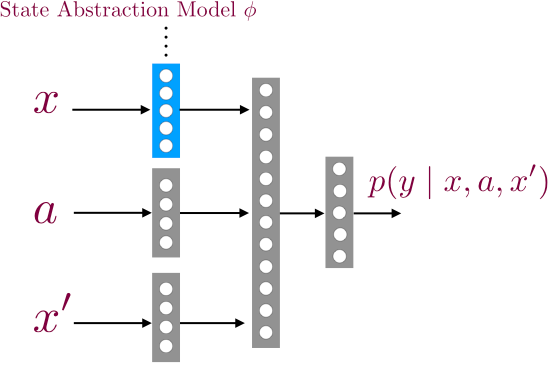
  • We then flip a coin; if we get heads then we store the transition (x1, a1, x’1), and otherwise we store the imposter transition (x1, a1, x’2). We train a supervised classifier to predict if a given transition (x, a, x’) is real or not.
    This classifier has a special structure which allows us to recover a decoder for time step h.
  • Once we have learned the state decoder, we will learn an exploration policy for every possible value of the decoder (which we call abstract state as they are related to the latent state space). This step is standard can be done using many different approaches such as model-based planning, model-free methods, etc. In the paper we use an existing model-free algorithm called policy search by dynamic programming (PSDP) by Bagnell et al. 2004.
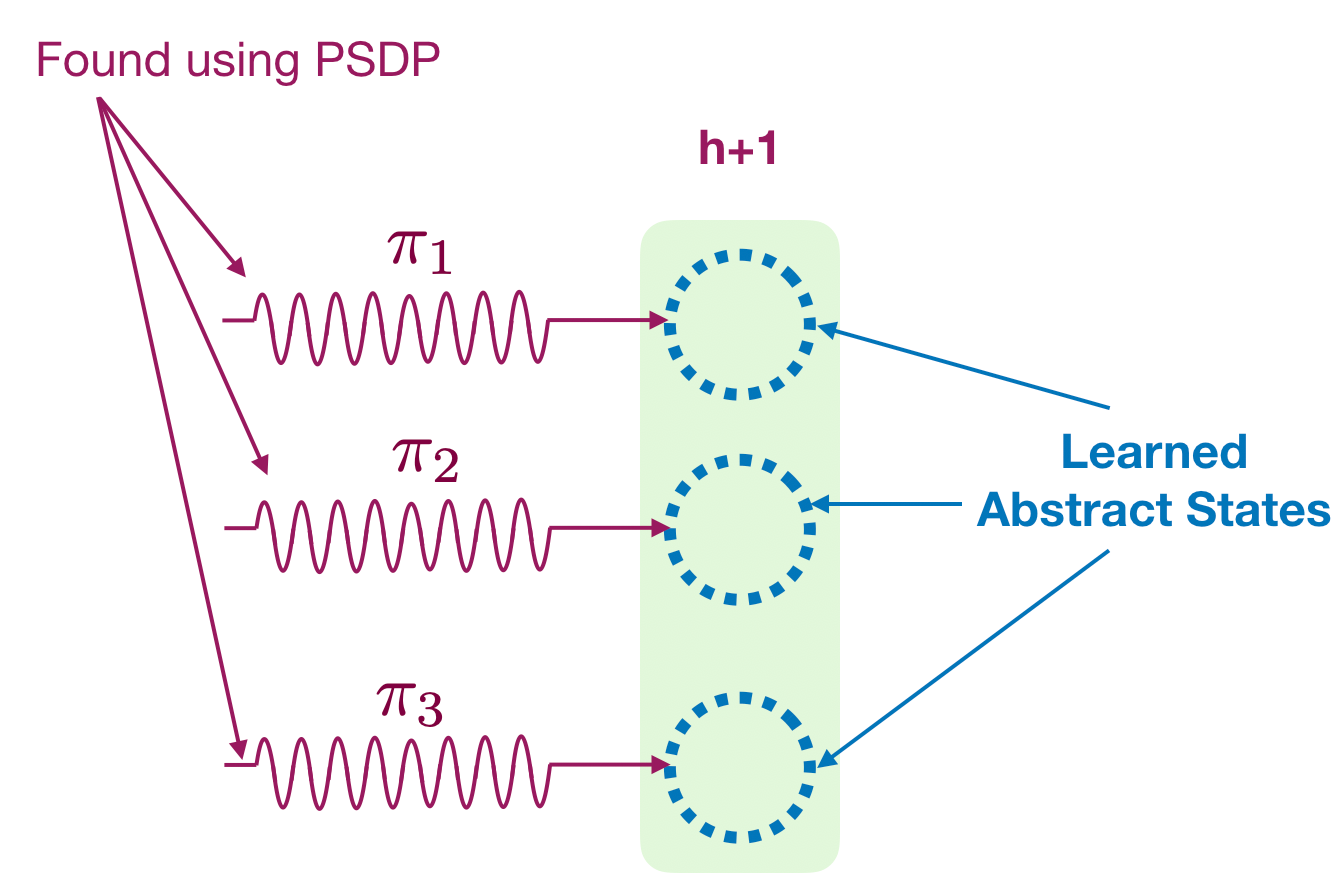
  • We recovered a decoder and a set of exploration policy for this time step. We then keep doing it for every time step and learn a decoder and exploration policy for the whole latent state space. Finally, we can easily optimize any given reward function using any provable planner like PSDP or a model-based algorithm. (The algorithm actually recovers the latent state space up to an inherent ambiguity by combining two different decoders; but I’ll leave that to avoid overloading this post).

Key findings

HOMER achieves the following three properties:

  1. The contrastive learning procedure gives us the right state decoding (we recover up to some inherent ambiguity but I won’t cover it here).
  2. HOMER can learn a set of exploration policies to reach every latent state
  3. HOMER can learn a nearly-optimal policy for any given reward function with high probability. Further, this can be done after exploration part has been performed.

Failure cases of prior RL algorithms

There are many RL algorithms in the literature and many new are proposed every month. It is difficult to do justice to this vast literature in a blog post. It is equally difficult to situate HOMER in this vast literature. However, we show that several very commonly used RL algorithms fail to solve the above problem while HOMER succeeds. One of these is the PPO algorithm, a widely used policy gradient algorithm. In spite of its popular use, PPO is not designed for challenging exploration problems and easily fails. Researchers have made efforts to alleviate this with ad-hoc proposals such as using prediction errors, counts based on auto-encoders, etc. The best alternative approach we found is called Random Network Distillation(RND) which measures novelty of a state based on prediction errors for a fixed randomly initialized network.

Below we show how PPO+RND fails to solve the above problem while HOMER succeeds. We simplify the problem by using a grid pattern where rows represent the state (the top two represents “good” states and bottom row represents “bad” states), and column represents timestep.

https://youtu.be/tjxl4kpd7Uw

We present counter-examples for other algorithms in the paper (see Section 6 here). These counterexamples allow us to find limits of prior work without expensive empirical computation on many domains.

How can I use with HOMER?

We will be providing the code soon as part of a new package release called cereb-rl. You can find it here: https://github.com/cereb-rl and join the discussion here: https://gitter.im/cereb-rl

Coronavirus and Machine Learning Conferences

I’ve been following the renamed COVID-19 epidemic closely since potential exponentials deserve that kind of attention.

The last few days have convinced me it’s a good idea to start making contingency plans for machine learning conferences like ICML. The plausible options happen to be structurally aligned with calls to enable reduced travel to machine learning conferences, but of course the need is much more immediate.

I’ll discuss relevant observations about COVID-19 and then the impact on machine learning conferences.

COVID-19 observations

  1. COVID-19 is capable of exponentiating with a base estimated at 2.13-3.11 and a doubling time around a week when unchecked.
  2. COVID-19 is far more deadly than the seasonal flu with estimates of a 2-3% fatality rate but also much milder than SARS or MERS. Indeed, part of what makes COVID-19 so significant is the fact that it is mild for many people leading to a lack of diagnosis, more spread, and ultimately more illness and death.
  3. COVID-19 can be controlled at a large scale via draconian travel restrictions. The number of new observed cases per day peaked about 2 weeks after China’s lockdown and has been declining for the last week.
  4. COVID-19 can be controlled at a small scale by careful contact tracing and isolation. There have been hundreds of cases spread across the world over the last month which have not created new uncontrolled outbreaks.
  5. New significant uncontrolled outbreaks in Italy, Iran, and South Korea have been revealed over the last few days. Some details:
    1. The 8 COVID-19 deaths in Iran suggests that the few reported cases (as of 2/23) are only the tip of the iceberg.
    2. The fact that South Korea and Italy can suddenly discover a large outbreak despite heavy news coverage suggests that it can really happen anywhere.
    3. These new outbreaks suggest that in a few days COVID-19 is likely to become a world-problem with a declining China aspect rather than a China-problem with ramifications for the rest of the world.

There remains quite a bit of uncertainty about COVID-19, of course. The plausible bet is that the known control measures remain effective when and where they can be exercised with new ones (like a vaccine) eventually reducing it to a non-problem.

Conferences
The plausible scenario leaves conferences still in a delicate position because they require many things go right to function. We can easily envision 3 quite different futures here consistent with the plausible case.

  1. Good case New COVID-19 outbreaks are systematically controlled via proven measures with the overall number of daily cases declining steadily as they are right now. The impact on conferences is marginal with lingering travel restrictions affecting some (<10%) potential attendees.
  2. Poor case Multiple COVID-19 outbreaks turn into a pandemic (=multi-continent epidemic) in regions unable to effectively exercise either control measure. Outbreaks in other regions occur, but they are effectively controlled. The impact on conferences is significant with many (50%?) avoiding travel due to either restrictions or uncertainty about restrictions.
  3. Bad case The same as (2), except that an outbreak occurs in the area of the conference. This makes the conference nonviable due to travel restrictions alone. It’s notable here that Italy’s new outbreak involves travel lockdowns a few hundred miles/kilometers from Vienna where ICML 2020 is planned.

Even the first outcome could benefit from some planning while gracefully handling the last outcome requires it.

The obvious response to these plausible scenarios is to reduce the dependence of a successful conference on travel. To do this we need to think about what a conference is in terms of the roles that it fulfills. The quick breakdown I see is:

  1. Distilling knowledge. Luckily, our review process is already distributed.
  2. Passing on knowledge.
  3. Meeting people, both old friends and discovering new ones.
  4. Finding a job / employee.

How (and which) of these can be effectively supported remotely?

I’m planning to have discussions over the next few weeks about this to distill out some plans. If you have good ideas, let’s discuss. Unlike most contingency planning, it seems likely that efforts are not wasted no matter what the outcome 🙂

Code submission should be encouraged but not compulsory

ICML, ICLR, and NeurIPS are all considering or experimenting with code and data submission as a part of the reviewer or publication process with the hypothesis that it aids reproducibility of results. Reproducibility has been a rising concern with discussions in paper, workshop, and invited talk.

The fundamental driver is of course lack of reproducibility. Lack of reproducibility is an inherently serious and valid concern for any kind of publishing process where people rely on prior work to compare with and do new things. Lack of reproducibility (due to random initialization for example) was one of the things leading to a period of unpopularity for neural networks when I was a graduate student. That has proved nonviable (Surprise! Learning circuits is important!), but the reproducibility issue remains. Furthermore, there is always an opportunity and latent suspicion that authors ‘cheat’ in reporting results which could be allayed using a reproducible approach.

With the above said, I think the reproducibility proponents should understand that reproducibility is a value but not an absolute value. As an example here, I believe it’s quite worthwhile for the community to see AlphaGoZero published even if the results are not necessarily easily reproduced. There is real value for the community in showing what is possible irrespective of whether or not another game with same master of Go is possible, and there is real value in having an algorithm like this be public even if the code is not. Treating reproducibility as an absolute value could exclude results like this.

An essential understanding here is that machine learning is (at least) 3 different kinds of research.

  • Algorithms: The goal is coming up with a better algorithm for solving some category of learning problems. This is the most typical viewpoint at these conferences.
  • Theory: The goal is generally understanding what is possible or not possible for learning algorithms. Although these papers may have algorithms, they are often not the point and demanding an implementation of them is a waste of time for author, reviewer, and reader.
  • Applications: The goal is solving some particular task. AlphaGoZero is a reasonable example of this—it was about beating the world champion in Go with algorithmic development in service of that. For this kind of research perfect programmatic reproducibility may be infeasible because the computation is to extreme, the data is proprietary, etc…

Using a one-size-fits-all approach where you demand that every paper “is” a programmatically reproducible implementation is a mistake that would create a division that reduces our community. Keeping this three-fold focus fundamentally enriches the community both literally and ontologically.

Another view here is provided by considering the argument at a wider scope. Would you prefer that health regulations/treatments be based on all scientific studies including those where data is not fully released to the public (i.e almost all of them for privacy reasons)? Or would you prefer that health regulations/treatments be based only on data fully released to the public? Preferring the latter is equivalent to ignoring most scientific studies in making decisions.

The alternative to a compulsory approach is to take an additive view. The additive approach has a good track record amongst reviewing process changes.

  • When I was a graduate student, papers were not double blind. The community switched to double blind because it adds an opportunity for reviewers to review fairly and it gives authors a chance to have their work reviewed fairly whether they are junior or senior. As a community we also do not restrict posting on arxiv or talks about a paper before publication, because that would subtract from what authors can do. Double blind reviewing could be divisive, but it is not when used in this fashion.
  • When I was a graduate student, there was also a hard limit on the number of pages in submissions. For theory papers this meant that proofs were not included. We changed the review process to allow (but not require) submission of an appendix which could optionally be used by reviewers. This again adds to the options available to authors/reviewers and is generally viewed as positive by everyone involved.

What can we add to the community in terms reproducibility?

  1. Can reviewers do a better job of reviewing if they have access to the underlying code or data?
  2. Can authors benefit from releasing code?
  3. Can readers of a paper benefit from an accompanying code release?

The answer to each of these question is a clear ‘yes’ if done right.

For reviewers, it’s important to not overburden them. They may lack the computational resources, platform, or personal time to do a full reproduction of results even if that is possible. Hence, we should view code (and data) submission in the same way as an appendix which reviewers may delve into and use if they so desire.

For authors, code release has two benefits—it provides an additional avenue for convincing reviewers who default to skeptical and it makes followup work significantly more likely. My most cited paper was Isomap which did indeed come with a code release. Of course, this is not possible or beneficial for authors in many cases. Maybe it’s a theory paper where the algorithm isn’t the point? Maybe either data or code can’t be fully released since it’s proprietary? There are a variety of reasons. From this viewpoint we see that releasing code should be supported and encouraged but optional.

For readers, having code (and data) available obviously adds to the depth of value that a paper has. Not every reader will take advantage of that but some will and it enormously reduces the barrier to using a paper in many cases.

Let’s assume we do all of these additive and enabling things, which is about where Kamalika and Russ aimed the ICML policy this year.

Is there a need for go further towards compulsory code submission? I don’t yet see evidence that default skeptical reviewers aren’t capable of weighing the value of reproducibility against other values in considering whether a paper should be published.

Should we do less than the additive and enabling things? I don’t see why—the additive approach provides pure improvements to the author/review/publish process. Not everyone is able to take advantage of this, but that seems like a poor reason to restrict others from taking advantage when they can.

One last thing to note is that this year’s code submission process is an experiment. We should all want program chairs to be able to experiment, because that is how improvements happen. We should do our best to work with such experiments, try to make a real assessment of success/failure, and expect adjustments for next year.

FAQ on ICML 2019 Code Submission Policy

ICML 2019 has an option for supplementary code submission that the authors can use to provide additional evidence to bolster their experimental results. Since we have been getting a lot of questions about it, here is a Frequently Asked Questions for authors.

1. Is code submission mandatory?

No. Code submission is completely optional, and we anticipate that high quality papers whose results are judged by our reviewers to be credible will be accepted to ICML, even if code is not submitted.

2. Does submitted code need to be anonymized?

ICML is a double blind conference, and we expect authors to put in reasonable effort to anonymize the submitted code and institution. This means that author names and licenses that reveal the organization of the authors should be removed.

Please note that submitted code will not be made public — eg, only the reviewers, Area Chair and Senior Area Chair in charge will have access to it during the review period. If the paper gets accepted, we expect the authors to replace the submitted code by a non-anonymized version or link to a public github repository.

3. Are anonymous github links allowed?

Yes. However, they have to be on a branch that will not be modified after the submission deadline. Please enter the github link in a standalone text file in a submitted zip file.

4. How will the submitted code be used for decision-making?

The submitted code will be used as additional evidence provided by the authors to add more credibility to their results. We anticipate that high quality papers whose results are judged by our reviewers to be credible will be accepted to ICML, even if code is not submitted. However, if something is unclear in the paper, then code, if submitted, will provide an extra chance to the authors to clarify the details. To encourage code submission, we will also provide increased visibility to papers that submit code.

5. If code is submitted, do you expect it to be published with the rest of the supplementary? Or, could it be withdrawn later?

We expect submitted code to be published with the rest of the supplementary. However, if the paper gets accepted, then the authors will get a chance to update the code before it is published by adding author names, licenses, etc.

6. Do you expect the code to be standalone? For example, what if it is part of a much bigger codebase?

We expect your code to be readable and helpful to reviewers in verifying the credibility of your results. It is possible to do this through code that is not standalone — for example, with proper documentation.

7. What about pseudocode instead of code? Does that count as code submission?

Yes, we will count detailed pseudocode as code submission as it is helpful to reviewers in validating your results.

8. Do you expect authors to submit data?

We understand that many of our authors work with highly sensitive datasets, and are not asking for private data submission. If the dataset used is publicly available, there is no need to provide it. If the dataset is private, then the authors can submit a toy or simulated dataset to illustrate how the code works.

9. Who has access to my code?

Only the reviewers, Area Chair and Senior Area Chair assigned to your paper will have access to your code. We will instruct reviewers, Area Chair and Senior Area Chair to keep the code submissions confidential (just like the paper submissions), and delete all code submissions from their machine at the end of the review cycle. Please note that code submission is also completely optional.

10. I would like to revise my code/add code during author feedback. Is this permitted?

Unfortunately, no. But please remember that code submission is entirely optional.

The detailed FAQ as well other Author and Style instructions are available here.

Kamalika Chaudhuri and Ruslan Salakhutdinov
ICML 2019 Program Chairs

ICML 2019: Some Changes and Call for Papers

The ICML 2019 Conference will be held from June 10-15 in Long Beach, CA — about a month earlier than last year. To encourage reproducibility as well as high quality submissions, this year we have three major changes in place.

There is an abstract submission deadline on Jan 18, 2019. Only submissions with proper abstracts will be allowed to submit a full paper, and placeholder abstracts will be removed. The full paper submission deadline is Jan 23, 2019.

This year, the author list at the paper submission deadline (Jan 23) is final. No changes will be permitted after this date for accepted papers.

Finally, to foster reproducibility, we highly encourage code submission with papers. Our submission form will have space for two optional supplementary files — a regular supplementary manuscript, and code. Reproducibility of results and easy accessibility of code will be taken into account in the decision-making process.

Our full Call for Papers is available here.

Kamalika Chaudhuri and Ruslan Salakhutdinov
ICML 2019 Program Chairs